

Curiosity may kill the cat, but it can make humans feel more alive. Photo by Bing Frost on Unsplash.
I’ve been wanting to write about feeding our curiosity, about the joy of discovery and experimentation for a while. One of the key reasons I was so drawn to user experience (UX) research for decades was that it untapped something I didn’t realize I’d lost – my sense of curiosity. As a child, I was typically the one asking all the questions. A hundred whys. I loved wandering into something new and taking it for a spin. UX research allowed me to dive into not only my love of curiosity, but genuine interest in learning from others. Most of the stories I heard fascinated me. The different approaches to the same task. Discovery research that involved learning about new products and the people that used or built them. There are even moments where I will get into a whimsy conversation with someone standing in the same line or working behind the counter. Every conversation is an opportunity to connect, but also to learn something new.
I recall being encouraged to discover, experiment, and learn as a child. At the most basic level, there are schools. But beyond that, I had an environment that allowed me to try different activities, to read about different topics, to mix my potions of inedible goodness in the kitchen.
And then it was simply gone. I’m not sure why or how, but I get the sense that transitioning into adulthood for many of us overindexes on surviving the day and building a life. However, I do not believe that adults become less curious. And I’m not alone. In a post about misunderstanding curiosity, Dr. Todd Kashdan writes that “Age is not what inhibits curiosity. A lack of interests, a lack of motivation in learning, a lack of humility, a lack of self-efficacy, and a lack of autonomy are what disable curiosity,” citing a 2004 paper he wrote with others.
As an adult, my relationship with curiosity and learning has definitely taken a different shape. In my 30s, I loved watching documentaries. Any documentary. From Jiro Dreams of Sushi, which I appreciated as a sushi lover, to Darkon, a documentary about a topic (live action role playing) I knew nothing about and honestly had no interest in. Today, I enjoy listening to the stories of others and doing a bit of urban and nature wanderlust, running into stores and forests that introduce me to new things.
Something to think about: curiosity may have seemed more appropriate as a child experiencing the world for the first time, but it’s still relevant (and beneficial) as adults. It's not weird. In fact, nurturing your curiosity might be one of the most human things you can do, and one of the most beneficial for your overall wellbeing.
It’s also important to understand that curiosity is energy. When you're curious, when you're learning something that genuinely interests you, and instead of draining your reserves, you're often filling them. That article that captured your attention at lunch? That documentary you got lost in? Those moments feed something essential in us.
I'd like to invite you to explore the interconnected relationship between curiosity, body, and mind. To find space for learning and exploration. It's time to get cozy with how curiosity and intellectual wellness can show up in your life in ways that fit your real pace and actual energy.
Creating Safety
I want to take a moment before we begin this journey to acknowledge that this work is very personal, intimate, and can bring up heavy and difficult feelings. While these are completely normal, it is possible that this moment is not the best time for this work. If that's the case, that's also okay. Perhaps bookmark this article, or make a note in a calendar to check back in a week or whatever feels good.
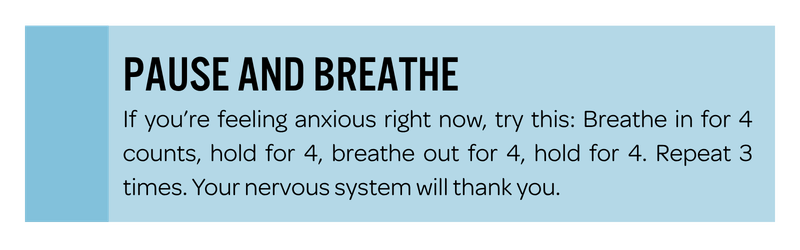
Give yourself permission to go slow, take breaks, or stop if you're overwhelmed. Having support systems and boundaries in place can help. Some tools in my self-care toolkit that I leverage when doing heavy inner work include:
Taking pauses, sometimes even setting a timer, to check in with my anxiety level. If I'm uncomfortable, it's a sign to take a break and pick this up again later.
Creating a comfortable space. This work can be anxiety-inducing enough; making the space around you calm and serene helps limit external stressors.
Having a safe person to reach out to if needed – that person you can vent anything to.
Box breathing helps me personally regulate my body in moments of stress.
What follows are compassionate ways to begin exploring your relationship with curiosity and strengthening your intellectual wellness.
Understanding Your Wellness Wheel
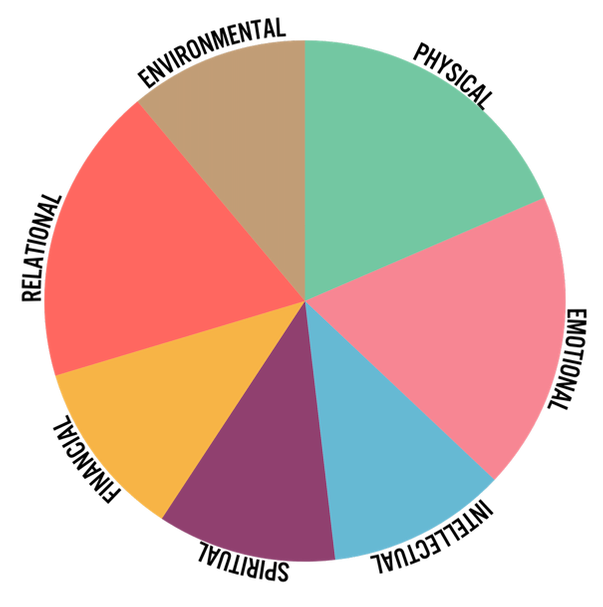
Your wellness wheel likely doesn’t reflect a perfect balance, and that’s okay
Improving your intellectual wellness has its benefits. On an episode of the Speaking of Psychology podcast, Dr. Rachel Wu talks about her research in the area of adult learning, and “that there actually can be quite a bit of movement in terms of your cognitive abilities if you’re learning a lot of new skills.” Personally, I believe that engaging in activities that stimulate learning and curiosity can also up the variety and joy factor in our days, and who doesn’t want more joy?
This is why I approach intellectual wellness as part of a holistic picture. Learning and growth can have impacts on your cognitive health and your career confidence, not to mention possibly forging new relationships. When curiosity and wellness work together, the ripple effects touch every area of your life.
Courting the “I Don’t Know”
Have you ever been in any of the following situations:
Being asked a question during a work meeting, and while there’s a legitimate reason for not having an answer, it might’ve felt like any answer was better than “I don’t know.”
Entering a conversation at a social gathering about a show or topic you weren’t familiar with, but just being silent or nodding in agreement was easier than saying, “I haven’t seen that show.”
Why do we feel so embarrassed and ashamed about not knowing? Sometimes it seems obvious that I'm not an omnipotent being, but I've been in plenty of situations where I still chose to pretend. I'm getting much better at saying “I don't know,” but I'm not perfect at it. Just last month, I went along with a conversation when I had no idea what was being referenced. And it wasn't even an important topic.
The best place to start is often with baby steps. Take a moment and recall a situation where you were uncomfortable saying “I don't know.” Then pause. Notice what feelings arise or shift. Does your breathing speed up? Your heart rate? Does your body become tense? Perhaps you're surprised that acknowledging it isn't as bad as you'd imagined.
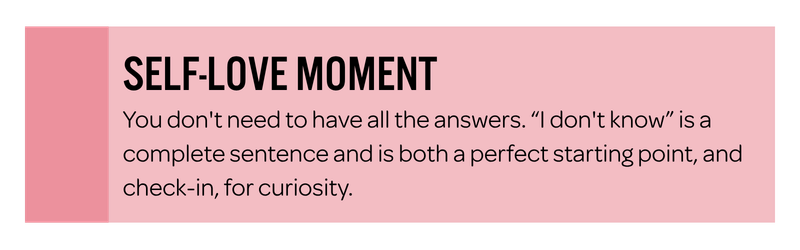
It can be tough to feel like we don't have all the answers, to admit we're imperfect. But it can also be extremely liberating, because once you can say “I don't know,” you open the door to “but I'd love to find out.” This is what psychologist Carol Dweck calls developing a growth mindset in her 2014 TED talk, Teaching a Growth Mindset. When we believe our abilities can grow, “I don't know” becomes an invitation rather than an ending.
Untangling Your Story of Knowing
Being afraid of not having all the answers, or feeling ashamed about embracing curiosity, can be a learned behavior. We absorb more from our childhood environments than we might realize. Maybe you experienced shame for not knowing answers in class. Maybe you witnessed parent-figures fumbling for answers or nodding along to unfamiliar topics. Maybe most of the adults you knew had lives that revolved around home and work, without many hobbies or visible interests outside of survival.
These early messages shape how we approach learning as adults. But the beautiful part about growing into our own selves is that we get to rewrite those stories.
Exploring aspects of our holistic wellness through journaling and reflective prompts is something I do with clients (and myself) a lot so I’m sharing some prompts here that might be useful when thinking about your own relationship with curiosity and learning. Feel free to grab your favorite journal or journaling app, the perfect pens, and cozy up. The prompts below can be used individually, in conjunction with, or any combination of that.
What messages did you receive about your intelligence or ability to learn? From whom?
What moments in your life made learning feel safe or exciting? What made it feel scary or shameful?
What would you tell your younger self about learning and curiosity?
One thing that is important to remember is that while these stories may seem real, not all of these stories are true. And you get to choose how curiosity, exploration, and intellectual wellness shows up in your life, and how much space it is given in terms of your overall wellness. Some wellness areas naturally require trade-offs with others. It's about finding an imperfect balance that works for your unique life and season.
This process can be an opportunity to think through what intellectual wellness means to you right now at this moment. Maybe you really do want to be on Jeopardy. But perhaps you want to allow more space to try new things, lean into an old (or new) hobby, or just acknowledge how it shapes you. And know that your relationship with curiosity right now doesn’t have to be what it is forever. Remember to come back to your wellness wheel as your relationship with curiosity evolves.
A Curiosity Vitality Check
Now that you've explored where your learning story came from, let's check in on where you are right now. I know this work can feel heavy in our bodies and emotions, so remember to reference the Creating Safety section above for tips on bringing calm into this process. When you're ready, grab whatever journaling tools feel right and dive in.
Here are a few questions that might help you start to frame out your relationship with your intellect:
On a scale of 1-5, how would you rate your current relationship with learning and curiosity?
In a few words, how do you feel about learning right now? (use adjectives, emotions, whatever comes to mind)
When was the last time you followed a curiosity rabbit hole? What was it about?
After reflecting on these questions, what's one small thing you want to explore this week?
Tending Your Inner Explorer
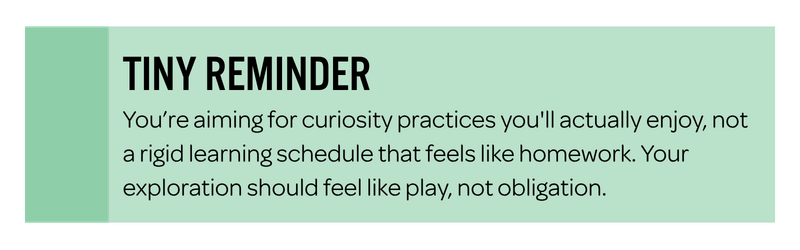
If you've explored your learning story and checked in with your current curiosity levels, you're ready to start building small, sustainable practices that feed your natural wonder. These practices are more about helping nurture the part of you that wants to know things just because rather than being about becoming more productive.
The idea of feeding your natural wonder can seem counterintuitive to how we have traditionally learned to live as adults. Society often points us in the direction of learning to get the edge in our career, to make more money, to be considered an expert in a particular area. But feeding our curiosity and allowing a sense of playfulness to enter can be a refreshing break that also feeds our intellect. It’s a way that allows us to learn for us, not for others.
If you're wondering where to start, here are some ideas:
Keep a “wonder list” on your phone of topics you want to explore
Read one article about something that interests you (not work-related)
Browse a library or bookstore without pressure to buy or borrow, but just exploring
Tips for Different Learning Styles:
If you love structure: Schedule a "learning hour" weekly with specific topics
If you love alone time: Solo learning through books, videos, online courses
If you love community: Learning circles, classes, discussion groups
Also check out 5 Little Things I Do To Keep My Brain Sharp for other tips on supporting brain health through curiosity.
Brain Dates That Spark Joy
Learning doesn't have to be solitary. Sharing what you're curious about and discovering what others are exploring can deepen both your understanding and your relationships. But talking about learning can feel vulnerable. What if you seem pretentious? What if you get facts wrong? Here's how to share your curiosity in ways that feel genuine and inviting.
Ways to share your curiosity:
Share discoveries without proclaiming expertise by simply saying, "I just learned the coolest thing..." rather than "Did you know..."
Initiate curious conversations with friends, family, and partners by asking what they've been wondering about or if they've learned something new recently.
Learn with others by exploring topics together or asking a friend who knows a skill to teach you.
Need help starting those conversations? Try these:
"I've been curious about [topic] lately - have you ever wondered about that?"
"I fell down a rabbit hole about [topic] - want to hear the weirdest thing I learned?"
"What's something you've been wanting to learn more about?"
The Ripple Effect: When Curiosity and Wellness Work Together

Curiosity thrives when we give ourselves permission to play. Photo by Vitaly Gariev on Unsplash
Intellectual wellness and curiosity ripple out into every other area of your holistic wellness. When you create space for joyful learning, you might find new communities forming around shared interests (relational and environmental wellness). You might discover a hobby that becomes a side income stream or makes you more valuable in your current career (financial wellness).
Finding hobbies that spark genuine interest brings joy. And joy? Joy reduces stress, improves sleep, strengthens relationships, and gives you energy for everything else in your life.
This is why I believe curiosity is a vital part of intellectual wellness, which also can't be separated from holistic wellness. In my coaching practice, I see how rekindling curiosity often unlocks breakthroughs in other areas, from deeper relationships when you have interesting things to talk about, to lower stress levels when your brain gets the stimulation it craves, and confidence boosts from learning you're capable of mastering new things.
Your curiosity is a journey, not a destination. Every small step you take toward wonder, whether it's following a Wikipedia rabbit hole, trying a new craft, or simply saying “I don't know, but I'd like to find out,” is building a foundation for lifelong mental vitality and joy.
Getting cozy with your curiosity isn’t about becoming an expert in a hundred topics. But it is about acknowledging and giving yourself permission to explore the parts of this world that spark your interest. And it's about remembering that learning can be playful, not productive. That wondering is enough.
Want to go deeper? I've created Getting Cozy With Your Intellect, a wellness reflection guide that includes more space for journaling, guided prompts, and exercises to help you deepen your personal relationship with your intellect. It's designed as a companion to this article, giving you a structured way to explore what intellectual wellness looks like in your real life. It's available now in the Imperfect AF shop on Etsy, along with the rest of the Getting Cozy series.
Ready to explore how intellectual wellness connects to every other area of your life? I'd love to support you in creating your own perfectly imperfect approach to curiosity and wellness. Because when you embrace your natural wonder with compassion and permission, everything else starts to shift too.
